DC-DC Chargers for 4WD, Caravans & Camping
Keep your batteries charged and your adventures powered with our range of DC-DC chargers at All 12 Volt. Designed for dual battery setups, these chargers deliver safe, efficient charging from both your alternator and solar panels.

Showing all 9 resultsSorted by price: low to high


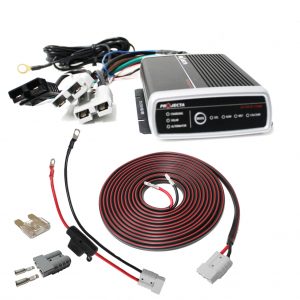


A DC-DC charger (also called a battery-to-battery charger) is the most reliable way to charge an auxiliary battery from your vehicle’s alternator. Unlike older voltage-sensing relays (VSRs), a DC-DC charger uses a multi-stage charging profile to correctly charge AGM, GEL and lithium deep-cycle batteries — and it works properly with modern smart alternators that vary their output voltage.
Whether you’re building a dual battery setup for a 4WD, caravan, camper trailer or work ute, the right DC-DC charger protects your batteries, extends their life and keeps your fridge, lights and devices running wherever the road takes you.
A DC-DC charger sits between your vehicle’s starter battery and your auxiliary battery. It takes the variable voltage from your alternator and converts it into a precise, regulated multi-stage charge — just like a mains battery charger, but drawing its power from your alternator while you drive.
This matters because a direct connection or a basic VSR will undercharge modern AGM and lithium batteries. Undercharging shortens battery life dramatically. A quality DC-DC charger applies the correct bulk, absorption and float stages every time.
| Feature | DC-DC Charger | VSR |
|---|---|---|
| Works with smart alternators | ✅ Yes | ❌ No |
| Multi-stage charging profile | ✅ Yes | ❌ No |
| Safe for lithium batteries | ✅ Yes | ❌ No |
| Isolates batteries when engine off | ✅ Yes | ✅ Yes |
| Price range (AUD) | $150–$600+ | $30–$80 |
| Best for | Modern 4WDs, caravans, lithium setups | Older vehicles, basic AGM setups only |
At All 12 Volt, we recommend a DC-DC charger for any vehicle made after 2015. Smart alternators in modern vehicles like the Ford Ranger, Toyota HiLux, Isuzu D-Max and Mitsubishi Triton actively reduce alternator output when they detect a full starter battery — which means a VSR may stop charging your auxiliary battery within minutes of starting the engine.
Choosing the right DC-DC charger comes down to three things: amperage output, battery chemistry compatibility, and whether you want a built-in solar input.
DC-DC chargers are rated in amps — typically 10A, 20A, 25A or 40A. The higher the amp rating, the faster your auxiliary battery charges while driving.
A 25A DC-DC charger puts roughly 25 amp-hours into your battery per hour of driving — so a flat 100Ah battery will be close to full after 4 hours on the road.
Not all DC-DC chargers charge all battery types. Always confirm compatibility before you buy.
| Battery Type | Charging Profile Required | Notes |
|---|---|---|
| AGM | Multi-stage: 14.4–14.7V absorption | Most common auxiliary battery type |
| GEL | Lower absorption: ~14.1V | Requires GEL-specific profile |
| Lithium (LiFePO4) | Constant current / constant voltage to 14.4V | Must have a lithium-specific mode |
| Calcium | Higher absorption: up to 16.2V | Less common in 4WD setups |
Important: Using an AGM-profile charger on a lithium battery will damage it over time. Always confirm the charger supports your battery chemistry before purchasing.
Many DC-DC chargers include a built-in MPPT solar regulator, letting you connect a rooftop solar panel and charge from both the alternator and the sun simultaneously. This is ideal for caravanners who park for multiple days between drives, campers who want to minimise engine-run time, and anyone running a large 12V fridge full-time.
Cable sizing tip: A 25A charger on a 3m cable run needs a minimum of 6mm² cable. Always protect the cable with an ANL fuse close to the source battery.
If you’re unsure about mounting location or wiring, our Gregory Hills workshop offers professional DC-DC charger installation. We service customers across Camden, Campbelltown, Liverpool and the Macarthur region.
A VSR connects your auxiliary battery to the alternator when it detects charging voltage, but provides no control over the charging profile. A DC-DC charger actively regulates charging using a multi-stage process, making it safe for AGM and lithium batteries and compatible with modern smart alternators.
Yes. Smart alternators (standard on most vehicles made after 2015 including the Ford Ranger, Toyota HiLux and Isuzu D-Max) reduce their output when the starter battery appears full. A VSR will disconnect your auxiliary battery within minutes of starting. A DC-DC charger bypasses this problem entirely.
Yes, but only if the charger has a dedicated lithium (LiFePO4) charging mode. Standard AGM-profile chargers will not fully charge a lithium battery and can cause damage over time. Always confirm lithium compatibility before purchasing.
A 25A charger delivers approximately 25Ah per hour of driving. A flat 100Ah AGM battery will take roughly 4–5 hours to reach full charge. A 40A charger will complete the same job in around 2.5–3 hours.
For a 3–4 metre cable run with a 25A charger, use a minimum of 6mm² (B&S 10) cable. For longer runs of 4–6 metres, step up to 8mm² cable to minimise voltage drop. Always fit an ANL fuse close to the source battery.
Many DC-DC chargers include a built-in MPPT solar regulator, allowing you to connect solar panels directly. This charges your auxiliary battery from both the alternator while driving and solar while parked — through a single unit. Check the maximum solar input wattage for your specific model.

Who does not love the outdoors and camping? It's a great adventure and opens up new destinations and often unexplored places. But you need to be well equipped with the safe and durable caravan and camping accessories for these outdoor activities. It is undoubtedly thrilling and exciting, but unless you take good care of what you need to do and what you should avoid, there's always a chance of an unpleasant experience. It pays to take sound advice from a 4WD specialist when going on a camping trip.